
Taxes on Rental Income in Spain (2026): IRPF, Modelo 210, VAT and Tourist Taxes
How rental income is taxed in Spain in 2026: IRPF for residents, Modelo 210 for non-residents, the new 2027 deadline, VAT on holiday lets and tourist taxes.
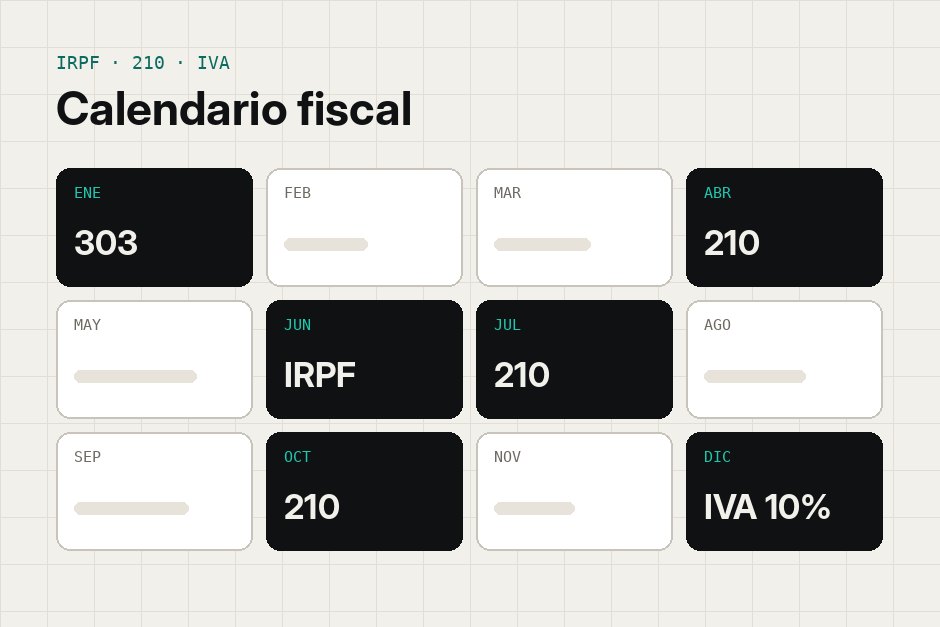
How a rental is taxed in Spain depends on two things: whether you are tax-resident in Spain, and whether you let the property to holiday guests or to long-term tenants. This guide covers the four pieces most owners meet — income tax for residents (IRPF), the non-resident return (Modelo 210), VAT on holiday stays and tourist taxes — as they stand on 30 October 2026.
It is a summary to help you prepare, not tax advice. Rates and deadlines change, and your gestor or tax adviser should confirm your case.
Residents in Spain: IRPF
If you are tax-resident in Spain, rental income goes into your annual income tax return. When you let a home without hotel-type services, it counts as income from real estate capital:
- Expenses are deductible: community fees, IBI, insurance, utilities you pay, repairs, cleaning, platform commissions and mortgage interest, within the legal limits.
- Depreciation: 3% a year of the value of the building — not the land — plus furniture and appliances.
- Holiday lets: general expenses of the property are deducted in proportion to the days it was let.
- No reduction for tourist lets: the reduction for letting a home as a dwelling, between 50% and 90% depending on the case, does not apply to holiday apartments.
- Empty days are taxed as imputed income: a percentage of the cadastral value — 2%, or 1.1% where it was recently revised — in proportion to the days.
Non-residents: Modelo 210
If you are not tax-resident in Spain, you file Modelo 210 for the income from each property:
| You live in | Rate | Taxed on |
|---|---|---|
| The EU or the European Economic Area | 19% | Net income: rent minus deductible expenses, in proportion to the days let |
| Anywhere else, including the UK | 24% | Gross income, with no expenses deducted |
A double tax treaty can change the rate, and the months a property stands empty are declared separately as imputed income.
New deadline from 2027. Order HAC/623/2026 changed when rental income is declared. Income from 2026 declared in one annual return is filed between 1 and 20 April 2027. Quarterly returns for April to September 2026 keep their old deadlines, the first 20 days of July and October 2026; from the last quarter of 2026 they also move to 1–20 April 2027. Returns filed from 2027 also ask for the number of days let, your share of ownership and an annex of expenses.
VAT on holiday stays from December 2026
Renting a furnished home has been exempt from VAT unless the owner provides hotel-type services, such as cleaning or linen changes during the stay or a reception, in which case 10% VAT already applies. Royal Decree-law 29/2026 removes the exemption from 1 December 2026 for stays of up to 30 nights in a home that is not the owner's habitual residence: they move to 10% VAT. Longer stays remain exempt.
If the decree stands, owners of holiday lets would have to register for VAT (Modelo 036), issue an invoice with VAT for each stay, and file quarterly returns (Modelo 303) and an annual summary (Modelo 390). The first quarterly return would cover December 2026 and be due by 30 January 2027. The decree must be validated by Congress, with the vote scheduled for 12 November 2026, so check the outcome before you act. Issuing invoices also brings in VERI*FACTU.
Tourist taxes
Spain has no national tourist tax. Some regions and cities charge one per guest and night, collected by the host:
- Catalonia, with a higher rate in Barcelona;
- the Balearic Islands, with lower rates out of season;
- some Galician cities, such as Santiago de Compostela, A Coruña and, since October 2026, Vigo.
The Valencian Community, Andalusia and Madrid had no tourist tax in October 2026. Rates and exemptions — usually by age and length of stay — are set locally, so check with your municipality.
A simple record-keeping routine
- Record every booking and every expense against its property as it happens, with who paid.
- Keep invoices and receipts per property and per year.
- Note the days each property was let, empty or used by you: every regime above needs them.
- Send your gestor one report per property each quarter, not a box of receipts in April.
How Hostfinn helps
Hostfinn doesn't file returns. It turns your bookings and expenses into reports that follow the official models — income tax for residents, Modelo 210 for non-residents, VAT and tourist tax — and an annual pack for your gestor. See vacation rental expense tracking for the categories that matter, and our SES.Hospedajes guide for guest registration.
Frequently asked questions
Can I deduct expenses as a non-resident?
Only if you live in the EU or the European Economic Area; then you pay 19% on net income. Residents of other countries, including the UK, pay 24% on gross income without expenses.
When do I declare 2026 rental income as a non-resident?
Between 1 and 20 April 2027 for an annual return, and for quarterly returns covering October to December 2026. Income from April to September 2026 keeps the old quarterly deadlines in July and October 2026.
Do I have to charge VAT on my holiday let?
From 1 December 2026, for stays of up to 30 nights in a home that is not your habitual residence — if Congress validates Royal Decree-law 29/2026. Before that, only if you provide hotel-type services.
Does the rental reduction apply to holiday lets?
No. The reduction for letting a home as a dwelling does not apply to tourist apartments.