
SES.Hospedajes Explained: How Holiday Lets in Spain Report Bookings and Guests
What SES.Hospedajes requires from holiday let owners and co-hosts in Spain: who reports, the 24-hour deadline, which data, the fines and how to send it.
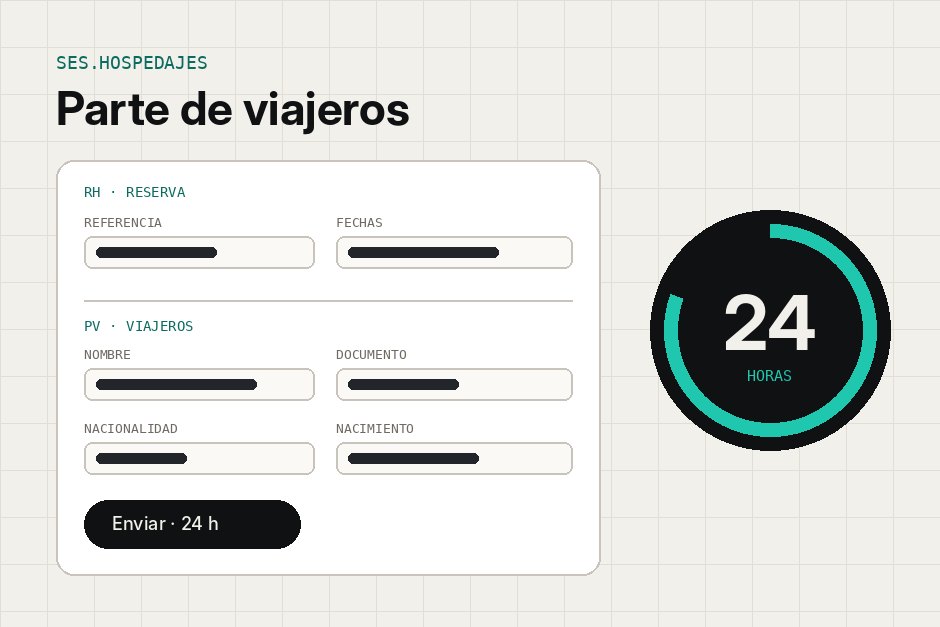
Every holiday let in Spain has to report each booking and each guest to the Ministry of the Interior through an online platform called SES.Hospedajes. The rule comes from Royal Decree 933/2021 and has applied since 2 December 2024 — to an owner with one apartment as much as to a hotel.
This guide explains who has to report, what and when, how to send the data, what happens if you don't, and how to keep the work manageable. It is general information, not legal advice; the Ministry's own pages are the reference.
What is SES.Hospedajes?
SES.Hospedajes is the Ministry of the Interior's system for the documentary record of guests. It replaced the old police guest forms with one digital channel and a longer list of data, which now includes details of the booking and of the payment.
Who has to report?
The decree covers anyone who provides accommodation for payment — hotels, hostels, campsites, apartments and other tourist accommodation — and the digital platforms that intermediate those stays. In practice:
- Owners of holiday lets (viviendas de uso turístico) who rent them out themselves.
- Co-hosts and management companies who run a property on the owner's behalf; the agreement should say who reports.
- Booking platforms, which have their own reporting duties; these do not replace yours.
Catalonia and the Basque Country work differently: guest data goes to the regional police, the Mossos d'Esquadra and the Ertzaintza, through their own systems.
What has to be reported, and when?
There are two communications. Each is due immediately and in any case within 24 hours (article 6 of the decree):
| Communication | When | Main data |
|---|---|---|
| Reservation (the contract) | When the booking is made, and again if it is cancelled | Booking reference and dates, number of travellers, the property, and the payment method with its identifying details |
| Guest registration (parte de viajeros) | When the stay starts | For each traveller: name, sex, date of birth, nationality, ID document, address, phone and email; for minors, their relationship to the adult |
The complete list is in Annex I of the decree. The records must be kept for three years from the end of the stay.
How to send the data
Before sending anything, you register as a provider on the Ministry's electronic office and register each property as an establishment, using a digital certificate, Cl@ve or an electronic ID. Each establishment gets its own code. Then there are three ways to report:
- By hand, filling in the web form on the SES.Hospedajes site for each booking and each guest.
- By file, uploading batches in the format the Ministry publishes.
- Through software connected to the Ministry's web service, which sends the reservation and the guest registration from the data you already keep.
Fines
Breaches are sanctioned under the citizen security law, Organic Law 4/2015. Reporting late or with incomplete data is usually treated as a minor infringement, with fines from €100 to €600; not keeping the record or not reporting at all can be a serious one, from €601 to €30,000. Data protection rules apply on top: guest data has to be stored securely and deleted when the three years are over.
How to keep it manageable
- Collect guest data before arrival. Ask for ID details when you send check-in instructions, not at the door.
- Send the reservation as soon as it is confirmed. The 24-hour clock starts with the booking, not with the arrival.
- Keep one record per booking. When the reservation, the guests and the submissions live together, a cancellation or a change of guest is easy to follow up.
- Agree roles with the owner. If you co-host, the contract should say who reports and with which credentials.
How Hostfinn handles SES.Hospedajes
Hostfinn connects to the Ministry's web service. You link each property to its establishment code, complete the guest details in the booking, and Hostfinn checks them against the Ministry's rules before sending the reservation and the guest registration — when you press send, or automatically. Each submission shows its status, and a rejection comes with the Ministry's code and an explanation. Guest data is stored encrypted and covered by a data processing agreement.
Bookings, expenses and owner statements for the same properties stay in one place. For the wider picture, read vacation rental software in Spain; for the tax side, taxes on rental income in Spain.
Frequently asked questions
Does SES.Hospedajes apply if I only rent out one apartment?
Yes, if you let it to guests for payment. The obligation depends on the activity, not on the number of properties.
Who reports when a co-host manages the property?
Whoever the agreement names. Put it in writing, and make sure the credentials used belong to the right provider and establishment.
Does Airbnb send the guest data for me?
No. Platforms have their own reporting duties, but they do not replace the report of whoever provides the accommodation.
How long must I keep guest records?
Three years from the end of the stay. After that they should be deleted.